Saturday, 7 March 2015

Surviving a knife attack

Assume nothing.  It's a pretty blunt way to start a treatise on dealing with sharp weapons, but it's also a concise way of summing up.  The hand coming towards you may be empty but, in the fractions of a second by which a violent encounter turns, you may realise that the hand wasn't empty when it is already too late.  Bearing this in mind, it would be a good idea to look at how we might survive an attack with a bladed weapon, or at least give ourselves a better chance.

I'm not going to go into great detail about my experience with knives, but I suppose this reassures some people that I know what I'm talking about.  Growing up in Manchester, I witnessed a knife attack from a distance.  When I had to face a blade myself, I was relatively lucky.  My attacker was drunk, and seemingly unsure about whether they really wanted to cut me or put a hole in me.  In that situation, the judo I had learned up to that point, combined with some necessary improvisation, was enough for me to gain control of the situation.  I escaped unharmed.  This is unusual.

I apologise for any offence I may cause here, but the eskrima class I attended was a disappointment.  I can tell you that Filipino martial arts have excellent knife survival techniques but, like with everything else, this can be undone by poor teaching methods.  Many of the "knife defence" techniques I have seen are useful, but I see them being poorly implemented.  At worst, I see things which give a false sense of security, and may just get someone killed.

I will give credit to the instructors who say that the preferred option is always to run.  The only exception to that rule is where escape is not possible.  If an instructor neglects to mention this most important point, you should question whether they can reasonably be regarded as an expert on surviving a knife attack.

Rather than give you some set defences, which would be of limited use, I'm going to give you some principles.  The same principles are useful for an attack by any weapon, bladed or otherwise, including empty hands and feet.

1.  Don't be there

As previously stated, escape is always the preferred option.  The outcome of any encounter is always unknown, but a blade certainly stacks the odds in favour of the person holding the blade.  If escape is not possible, or the knife-wielding fiend is already close enough to make the attack, mobility is the key.  Your first priority must always, always be to get out of the weapon's way.  Those footwork drills that everyone neglects, because they want to get to the "fun" stuff - think of them as your best friend.  Whether you run, side step, move out of range or use a redirection technique, the principle is still the same: get out of the way.

2.  Defence

If you have managed to get out of the weapon's path, and especially if you haven't, controlling the path of the weapon is your next priority.  The two ways of doing this are to stop the weapon or to redirect the weapon.  Redirection is always the better option, because stopping the weapon's motion relies on the momentum of your block being greater than that of the weapon, whereas redirection makes use of the weapon's momentum.  If you are at all unsure of your ability to deliver a block with speed and power, then you must concentrate on learning to redirect an oncoming attack.

In the absence of anything else, the 360 degree defence from krav maga is pretty easy to learn.

3.  Hit

You may have heard stories of boxers surviving knife attacks.  Strange then, that knife defence videos seem to concentrate on applying locks.  It's all the more strange when you consider the fine motor skills that are needed to apply a joint lock.  All those pin sharp techniques you developed suddenly fly out of the window when a good dose of adrenaline hits your system.  Boxers are no stranger to adrenaline, and know that their best chance is to use those powerful punches they have trained time and time again.  Sure, it doesn't have the finesse of a perfectly executed joint lock, but that's the whole point.  We are dealing with simple, brutal and effective here.

More to the point, simultaneous attack and defence is the key.  If you're applying a block or redirection, it is advisable that it is accompanied with a strike of some kind.  What about kicking them as they approach?  You'll be lucky to get so much of a warning: the knife will usually be drawn when the attacker thinks you have the least chance of reacting.  If your attacker is stupid enough to make it obvious that he is drawing a knife at such a long range, I would still caution against kicking.  Half expect that your leg will be cut, affecting your mobility and, therefore, your chance of escape.

So, you've hit your attacker, possibly a few times.  Should you apply a lock?  Well, in the eyes of the law, if your opponent is stunned enough that you can apply a lock or throw, why did you not take advantage of this and escape?  If you are skilled enough, and immune enough to the effects of adrenaline, to disarm him or her, fair enough.  Otherwise, remaining with someone who is holding a blade and wants to use it is foolhardy in the extreme.

Summing up

Control, manoeuvre and hit, control, manoeuvre and hit, control, manoeuvre and hit.  As soon as a means of escape is available, take it.  If you hit your opponent hard enough to dump them on the ground, then run.  Never follow them to the ground: it puts you in a shaky position legally and you have lost the ability to easily escape.  If they have an accomplice, and you go to the ground, you're probably dead.

Filipino martial artists say that any improvised weapons that are available should be used.  I'll leave the legalities of this to one side and say that, from a practical standpoint, they're correct.

Always expect that you will get cut by a knife, and try to minimise the damage.  As I said, not getting cut is unusual.  Avoid being on the wrong end of a blade, if at all possible.  Of all the rules I could possibly pass to you regarding knife attack survival, that one is by far the most important.

Update

I came across a discussion about ground fighting against a knife, which broadly supports what I'm saying.  I took heed of the advice about the video, and decided not to watch it.

Wednesday, 4 March 2015

For the love of duotone

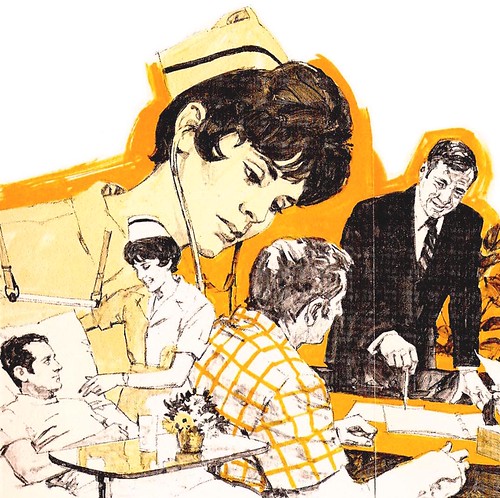
One of my fondest memories of being a child is the time I spent reading comic books, or comics, as we referred to them in the North of England at the time.  British comics, in particular, were printed in high volumes with the cost of printing very much in mind.  As a result, they were mostly either monochrome or duotone.  After much searching, I found a good explanation, and a few good examples of duotone illustrations at http://todaysinspiration.blogspot.co.uk/2008/05/charlie-allen-on-other-black-and-white.html

There is now no sound financial reason to produce duotone illustrations, as far as I am aware, and my worry is that the format will die.  You see, it doesn't matter how many forms of art I see, my favourite will always be duotone illustration.  Out of the examples given, I particularly like the one with the amber highlight colour.

I can't explain it, but there is something about the combination of black, white and amber in a duotone illustration that pleases me.  If I am ever successful in finding a suitable example, framed, it will be with great pleasure that I hang it on one of my walls.

Thought for the day: respect the wisdom of the ancients

"Do not deny the classical approach, simply as a reaction, or you will have created another pattern and trapped yourself there." ~Bruce Lee

I should stop reading the comments on YouTube: therein lies madness.  It should be enough for the users to slate wing chun but, when they give their reasons for believing it to be useless, something finally becomes clear.  They don't understand wing chun.

As the above quote suggests, believing that classical arts or thinking offer nothing of value is a mistake.  Things have changed, but not so much that we can allow ourselves to believe that our predecessors were somehow less cultured, less knowledgeable and less worldly than we are.  Such arrogance will mean that we lose so much accumulated wisdom, judging it to be outmoded or obsolete.

The world is a different place now.  Has the world changed for the better?  Maybe.  Has our world changed in ways that make things worse?  Maybe.  We like to think that the current pace of technological progress is faster than it has ever been.  Is that true?  More importantly, is it a good thing?  Maybe.  Is it a bad thing? Maybe.  If you're questioning my responses, you should watch the story of the Chinese farmer.

Again, Alan Watts represents a system of thought which came into being centuries before his birth.  I look at how busy our lives have become, how little time we spend with those we love, how technologies which were meant to promote communication have instead isolated us, and I wonder what the ancients would make of the assertion that we are more cultured, intelligent and civilised.

I see a growing interest in Buddhism here in the UK.  People who have turned away from our native religious traditions have turned towards ancient belief systems from elsewhere.  For what are they searching?  A sense that there is something more, something bigger, than our seemingly limited existence?  Some kind of moral code for a world where the old rules are no longer observed?  A feeling of calm to counter the stress and anxiety of the modern age?

Wing chun represents the old world.  To accept that it is still relevant is to accept that we haven't changed so much, and some would rather not accept such a notion.  It is better for them to believe that something of lesser value was created in the past, and has been made redundant by modern innovation.

Personally, I have found much of value in the thoughts of those who were here before me.

Sunday, 1 March 2015

Beneath the surface, all is dark

Today was a difficult day.  Even as I write those words, I realise that countless others will have had days which were immeasurably tougher than mine.  Maybe it would be more accurate to say that I didn't deal very well with the events of the day.  Much as I pride myself on my capacity for acceptance and tolerance, my personal reserves of those virtues seemed to be exhausted today.

Over the past few days, I've heard a name which I don't like to hear.  It's never an easy decision to turn our back on someone, especially for those of us who try to practise tolerance, but what if that person has been a constant source of trouble and suffering for us?  The situation is further complicated if it is a member of our family.  I'm not talking of hatred; it is simply a firm belief that letting my guard down again will lead to further trouble and suffering.  If I were to make allowances, one would be that this person was used, from a young age, as an agent for another who found my distress comical.  Unfortunately, setting such a pattern in infancy seems to have created a conditioned response to my presence, and I am seen as one who must be subjected to torment.

You might ask why I have heard this name many times over the past few days.  The rest of my family have gathered round this individual, offering their support, because she is responsible for another life being brought into the world.  Needless to say, I have stayed away, I have sent no card congratulating the new mother on the birth of her child, and the occasion means little to me.  What does mean something to me is that I find myself in an awkward position.  You see, this new mother has been a source of friction within the family many times, and those now rushing to her side have previously fallen foul of this aspect of her nature.  I hope, for their sake, that she has changed.

Ongoing problems with anti-social behaviour from my neighbour are another source of today's lack of tolerance.  To some degree, I have developed ways to cope with this issue, but the issue is still there.  When I saw examples of nationalistic bigotry today, caused by nothing more than a sporting fixture, it brought back memories of a time when I was subjected to that same bigotry on a daily basis.  Suddenly, it all became to much for me, and deeply held resentment came to the surface.

I have been reading a non-religious book by the Dalai Lama.  In this book, he writes about compassion and restraint.  Today, these were absent, along with acceptance and tolerance.  Compassion, or empathy, is the key here.  If I had made an attempt to understand the contributing factors in the behaviour of others, it may have been easier to tolerate such behaviour.  This is usually a strength of mine, but today I was found to be deficient in this respect.

Should I feel bad that I allowed a darkness from within to rise to the surface?  No.  If there had been any real damage done, I should try to repair that damage, admitting fault and apologising to anyone affected by my actions.  Beyond that, I should simply acknowledge that I did not show compassion, restraint, acceptance and tolerance when they were needed.  You see, compassion for ourselves is equally important.  We can never forget that we are only human, and we should forgive ourselves for occasional lapses from our greater virtues.

There will be some darkness within us, or, as Carl Gustav Jung suggested, a shadow side to our personality.  To deny this is to deny our humanity.  In more simple terms, it is impossible that every day will be a good day for us, without challenges, and finding these challenges difficult is not a crime.  We should practise acceptance, compassion and tolerance, not only for those who are external to us, but also towards ourselves.

Sunday, 22 February 2015

Leaving wing chun

There will be a time when I am no longer able to practise wing chun, at least in a formal setting.  At some point, for reasons I'm not going into here, learning wing chun in a class will no longer make sense.  It would be wise, therefore, to spend time learning how to make the most of solo practice.

I'm pretty obsessive when it comes to learning the forms.  I'm by no means perfect - I doubt that description would apply to anyone - but I've got the general structure of sil lum tao, chum kiu and the beginnings of biu jee.  What about the muk yan jong?  For now, I've changed the order for myself and, when I think about it, this is just one of many modifications I've made along the way.

Why study biu jee next, leaving the dummy form until later?  The best I can do is to say that, for me, it makes sense to learn the forms in that order.  Knowing that the next step is to be graded on muk yan jong does nothing to change that.  What I learn has to be effective when the brown, smelly stuff hits the spinning cooling device.  How one person makes wing chun effective will differ from how another makes it work for them.  The next step, at least in my practice away from the class, is to learn what I can from biu jee.

None of the above is meant to offend my instructor, who stands as the only one of the many martial arts instructors I've had that I'm actually able to respect.  Nor is it meant as an insult to those who came before him, who played their part in the history and development of wing chun.  In truth, these people serve as pointers of the way, and we may ultimately walk a different path or, as Bruce Lee did with jeet kune do, create our own path.

I have to train twice as hard to progress at the same pace as other students.  Again, I'm not going into the reasons for this, save to say that they are the same reasons that I know formal training in wing chun will, one day, no longer be in my interests.  Everyone's wing chun will be different, and I'm certain that my fellow students will realise that my wing chun is very different, but again I'm not going into the reasons for those adaptations being necessary.

In some ways, I have already left wing chun and, at the same time, am still very much involved in it.  If that sounds like a contradiction, you have to realise that no two people will do wing chun in that same way: they will naturally prefer some aspects of the art to others, and have their own interpretation of how things are done.  In effect, they have their own wing chun and have left a generalised understanding of wing chun behind them, though the same principles underpin what they do.  If they punch, is it wing chun, or is it simply a punch?

Arnis has also affected what I do.  Importantly, working with a weapon has a positive effect on hand-eye coordination.  In my opinion, if the ability to use improvised weapons is available, it is wise to take that option.  Again, adaptations are made, some of which aroused the concern of the instructor at the eskrima club I attended for a few months.  I was asked what style of Filipino martial arts I practise, because I made comparatively short, hacking movements with the stick, combined with a lot of thrusts.  For this reason, it was suggested that I had learned a style with a focus on bladed weapons as opposed to the sticks.  In reality, I was using the principles of wing chun, adapted to stick fighting: covering my centreline, not overextending, and so on.

To be fair, I train privately in modern arnis and kombatan, so those influences are obviously going to make themselves known if I have a weapon in my hand.  Maybe I'm picking it up wrong, but the focus of the arnis of Luzon seems to be on the shorter blades, as opposed to a focus on longer blades in the eskrima of the Visayas.  I have no doubt that I will be corrected, if I am mistaken.

I also noticed a striking similarity between the movements and principles of arnis and those of biu jee.  When you think about it, this makes sense.  The point of Filipino martial arts is that something has already gone very wrong, and you are probably on the wrong end of a bladed weapon.  Logically, this is not dissimilar to the idea in biu jee that we are fighting from a position of disadvantage.

I think I understand the past masters who took their secrets to the grave.  I see the lack of tolerance in the modern age, and I'm able to remind myself of my reasons for wanting an effective method of self-protection, but I also see an argument for advanced methods of combat being concealed.  I will occasionally walk by someone whose eyes are nervously darting all over the place, and I understand them.  As much as we like to think we are civilised, there is an ever present undercurrent of barbarism in our society; it has probably always been this way, and probably always will be.

Through the martial arts, I unwittingly internalised some of the teachings of Zen from an early age.  The irony of this is that, although I see the value of learning a method of combat, I have little desire to use it in anger and certainly no need to prove myself.  The motivation I have for learning martial arts is that humans continually fail to live in peace with each other and, in some cases, actively seek to prevent others living in peace.

As I've said before, I'm nowhere near considering myself a master, and probably never will, but there is still the idea that I should keep some of my relatively limited knowledge under my hat, as it were.  At the same time, I hope that what I choose to share proves to be valuable in some small way.

Wednesday, 11 February 2015

Becoming an expert

"If I have seen further it is by standing on the shoulders of Giants." - Sir Isaac Newton

I am occasionally consulted as an expert, in certain subjects, by friends, family and sometimes even acquaintances.  It is not, however, a one way thing.  If I know someone with specialist knowledge, I will consult them on matters relating to that knowledge: it just makes sense.  As I said, it's others who judge me to be the expert, not me, and I certainly don't believe I will ever have the necessary arrogance to consider myself a master of anything.

If I accept the notion that I have specialist knowledge, however, as there is clearly evidence to support this, then how did this happen?  How did I, or anyone else, surpass the knowledge of those with a passing interest in specific fields?  The clue, I would suggest, is in the question.  I know more than someone with a passing interest.

How easy would it be to develop a working understanding of something in which you have no interest?  It would be difficult, wouldn't it?  How about going beyond a basic understanding to a more comprehensive appreciation?  I don't know if it would be possible, but I expect it would be something akin to torture.

Becoming an expert in your chosen field takes patient study or practice, often over many years.  This can seem like a chore or, if you're genuinely interested in what you are doing, it can be very enjoyable.  Why would you choose to become an expert in something you don't enjoy?

Let us pursue those things which bring us joy in the pursuit of them.

Monday, 2 February 2015

Acceptance

Sometimes, things that I see, and hear, from family, friends and acquaintances, lead me to believe that people are becoming less tolerant.  I don't know whether it is the nature of modern forms of communication, such as social media, text messaging and others, or a more fundamental change in society, but there seems to be more of an "I win, you lose" attitude on display.

Maybe it's me.  I have to accept that I may be wrong about things.  For example, I see various movements which are supposedly concerned with creating equality, and yet they represent the interests of one group only.  I'm not saying that the groups that are represented are not disadvantaged, but the people who claim to represent them seek advantages for their chosen group, not equality.  Surely that isn't right?  I must be mistaken.  Maybe I'm looking at it all wrong.

Over the years, I have listened to many people and come into contact with many systems of belief.  Everyone goes through this, and our own beliefs are derived, at least in part, from what we take on board or reject.  How much of this is simple confirmation bias, we have no way of knowing.  Due in no small part to the aforementioned confirmation bias, our internal system of belief determines how we view and interact with our external world.

A personal view

My own way of dealing with others is based on a simple principle, which has more to it than appearances would suggest, though it can be summed up as follows:

1.  Understanding (optional)
2.  Acceptance

Is it surprising that understanding is optional?  It shouldn't be.  We should, of course, make an attempt to understand others, but is it always essential?  I would suggest that it isn't even always possible.  We do not all share the same experience, or background.  More to the point, based on what I have seen and heard recently, not everyone is able to empathise with others, or willing to even try understanding.

Am I suggesting it is possible to accept that which we don't understand?  I'm not just suggesting it is possible; I'm suggesting that it is essential.

Accepting without necessarily understanding

There are people, and viewpoints, we will never understand.  I don't understand terrorism, or racism, or any of the numerous forms of bigotry which are clearly not going away any time soon.  I can't condone these things, and that is not what accepting their existence is about.  Instead, I accept that some people hold beliefs which are abhorrent to me.  Having accepted this, I must ask myself what I can do about it, and accept that, in reality, there is little or nothing I can do.  Others are already fighting against these things, many of whom have more power and influence than I, so another thing I have to accept is that it is not my fight.

I started with an extreme example, so let me approach this from a less contentious angle.  Suppose that I had a friend who, for a hobby, liked to go base jumping.  It's not something that I understand, because I have no inclination to do it myself.  To me, it's a risky pursuit, and I have no intention of endangering my life needlessly.  However, that's just my point of view.  Do I question my friend's sanity, or our friendship, because we differ in this way?  No.  I accept that the friend will continue to go base jumping, even though I don't understand.

A recent example

Recently, a video clip has been circulating where a prominent atheist challenges belief in God.  The issue is that this person is relatively famous, is seen by a number of people as having a great deal of intelligence, and is denouncing a system of belief in a very public way.  It would be easy, and perhaps understandable, for those who feel they are the targets of his outburst to react with anger.  There are good reasons for religion and politics being taboo subjects in most workplaces: few things provoke such strong feelings, and few things are capable of causing such offence if mishandled.

How can we practise acceptance when faced with such a challenge to our beliefs?  Well, we must accept that others have a right to their beliefs, and also that these are the beliefs of just one person.  Some will point out that he is representative of atheism.  No, he isn't.  He is just one person, and I would guess that atheists do not all hold the same beliefs, beyond the one which defines atheism.  I have no reason to believe that he understands, or accepts, people who believe in God.  Then again, I have no reason to believe that he does not understand or accept those who believe in God.  He either accepts that others have beliefs which differ from his own, or he dismisses these people as deluded and not worthy of his time.  In terms which those who put their faith in science will understand, he is Schrödinger's atheist: given that he is in the entertainment industry, and therefore needs an audience for his livelihood, we must accept that the box may never be opened.

When acceptance leads to rejection

A few year's ago, a friendship that had lasted many years came to a sudden end.  Your first thought may be that my friend passed away but, as far as I know, he is alive and well.

There was a time when I hadn't seen my friend for many years, and seeing him again seemed to go well at first.  After a while, however, I started noticing things weren't quite right.  I don't know whether it was the time apart, or a greater level of maturity on my side, but I realised that certain patterns had always existed in the way we interacted.  In short, it had always been a one-sided friendship, and not a very good one.

What I had to accept was that the same patterns would keep repeating, and that I had spent a number of years fostering a relationship that didn't exist in reality.  The hard thing to accept was that the best course of action was to turn my back on someone I had regarded as a friend, however mistakenly.  Once it had been accepted, however, we just drifted apart.  In the time since, I've made new friends, and those are friendships that are actually worth keeping.

Learning to accept ourselves

Acceptance, you see, is not just about what we allow into our lives.  We must also accept that there are some things we need to let go.  This is especially true when we are seeking acceptance, especially from ourselves.  The whole self help industry thrives on us not being happy with who we are, feeling that we must change in some way.  Yes, it is healthy to let go of anger, mindfulness is a very useful thing and assertiveness also has its place, but there is a point at which we must be at peace with who we are.

If you feel that you are not good enough, when is that going to stop?  What will you have to change before you are finally happy with who you are?  Is it not better to treat yourself with kindness, acknowledge flaws where they exist and actually believe that you are fine as you are?  The main point here is to accept our flaws; whether we do anything about these flaws depends on their effect on us, and others.

I hope I have made my point.  It is better to come to accept something or someone through understanding, but understanding is not a prerequisite of acceptance.